AI Brain Fry: when coding agents produce more than a team can review
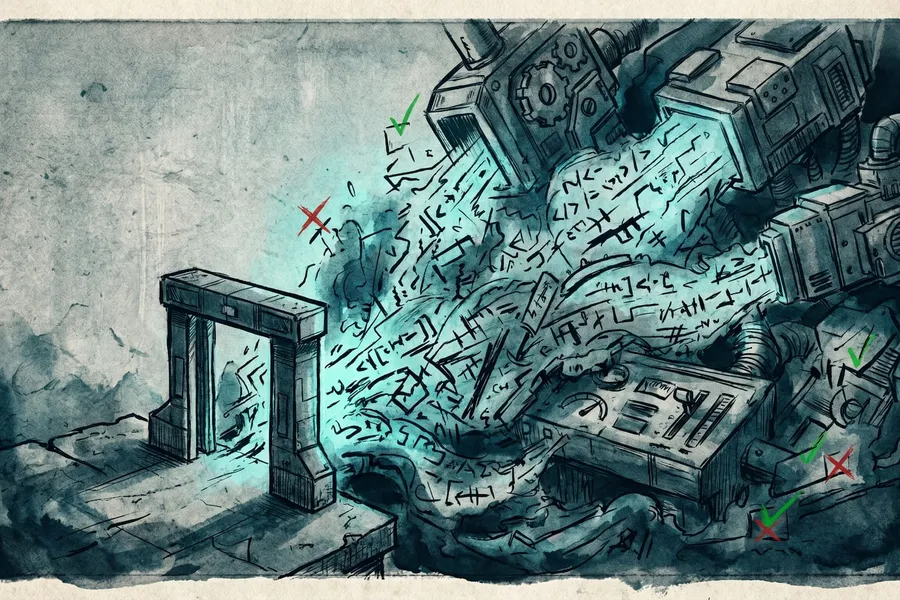
The Sorcerer’s Apprentice scene in Fantasia is still one of the best metaphors for automation.
Mickey does not fail because the broom does not work. He fails because it works too well. He delegates a task, the broom obeys, the work multiplies, and the problem stops being how to carry water. The problem becomes how to stop what has already been accelerated.
Something similar is starting to happen with coding agents.
For years, a meaningful part of the cost of software development was writing code. Translating a technical decision into implementation took time: understanding the domain, navigating the repository, writing, testing, breaking things, fixing them, and reviewing.
AI agents reduce that friction in a significant way. They can generate tests, refactors, endpoints, migrations, scripts, documentation, components, and explanations in a fraction of the time.
That is useful. Very useful.
But it also moves the bottleneck.
If the limit used to be producing code, it now starts to become reviewing, validating, understanding, and taking responsibility for that output.
And that part does not scale the same way.
Code review was already hard
A good review has never been just checking whether the code “looks good”.
Reviewing well requires context. You need to understand what problem is being solved, what tradeoffs were made, what debt is being accepted, and what impact the change may have on security, performance, maintainability, and operations.
It also requires judgment. Sometimes the important question is not whether the change works, but whether it should exist in that form.
That was already hard when human output was naturally limited by time, energy, and coordination. A team could write at roughly the same speed at which it could also discuss, review, and correct.
Coding agents break part of that balance.
A team can receive more PRs, faster, with reasonable explanations, generated tests, and diffs that look orderly at first glance. The change compiles. The model justifies its decisions. The description sounds professional.
And approving becomes tempting.
That is where AI brain fry appears.
What AI brain fry is
AI brain fry is not an academic term. It is a practical way to name the cognitive fatigue that appears when a team has to audit too much plausible output generated at industrial speed.
It is not simply tiredness.
It is the wear of reviewing a sequence of changes that look reasonable, are well explained, and require real attention to detect where the problem is. Each PR may look manageable in isolation. The damage appears in accumulation.
One change touches an edge of the domain.
Another introduces an abstraction that looks clean, but does not quite fit.
Another generates tests that validate the expected behavior, but not the real risk.
Another refactor makes the code cleaner locally, but harder to operate globally.
None of that necessarily looks like a fire in the moment. Often, it looks like progress.
That is the uncomfortable point: brain fry does not appear because the output is obviously bad. It appears because the output is coherent enough to require serious review.
The technical mind gets trapped between two costs:
- reviewing everything in depth;
- accepting that some generated work will enter the system with a shallow review.
The first does not scale. The second accumulates risk.
Fatigue-driven approval
When volume goes up, code review starts to change in nature.
At first, the team reviews with intention. It reads the diff, understands the context, questions decisions, asks for changes, and validates assumptions.
Then, if the pressure continues, a more dangerous dynamic appears: fatigue-driven approval.
Not because the team is irresponsible. Not because quality does not matter. Because attention is finite.
After enough plausible changes, judgment starts looking for shortcuts. The team relies more on tests having passed. It reads the agent’s explanation faster. It assumes that if the change is small, it is probably fine. It approves because there is no obvious signal to stop.
And in real systems, many bad decisions do not come with an obvious signal.
They come disguised as reasonable decisions.
A new function that duplicates a business rule instead of reusing it.
A migration that works, but leaves a difficult rollback path.
A test that covers the happy path and increases the feeling of safety.
A refactor that improves names, but changes the implicit ownership of part of the system.
A dependency that solves the immediate problem, but opens an operational risk nobody asked to review.
Fatigue-driven approval is dangerous because it does not feel like negligence. It feels like speed.
The team keeps moving. PRs close. The board advances. Output grows.
Until the system starts collecting payment for decisions nobody reviewed calmly enough.
Output is not progress
One of the traps of coding agents is that they make a classic technology confusion more visible: activity is not progress.
More commits do not mean a better product.
More lines do not mean better architecture.
More PRs do not mean more progress.
Sometimes they only mean more surface area to review, more implicit decisions to discover, and more potential debt entering the system with a more polished presentation.
The risk is not that AI writes bad code all the time. That would be relatively easy to detect.
The more uncomfortable risk is that it writes code good enough to pass a superficial review, but not good enough to support the system six months later.
That kind of problem does not always explode in the demo. It explodes when the team has already built on top of it.
That is why AI brain fry should not be treated as an individual concentration problem. It is not solved only by asking the team to “review better”.
If the system produces more technical decisions than the team can absorb, the problem is operational design.
The bottleneck moves to validation
The obvious answer would be to review more.
But reviewing more does not scale if the system is designed to produce much more than the team can validate with judgment.
When generation becomes cheap, technical work changes. The question stops being only “how do we produce faster?” and becomes “how do we avoid accepting changes we do not fully understand?”.
This requires designing operational limits for agents.
Limits like:
- which parts of the repository an agent can touch;
- which types of changes require mandatory human review;
- which refactors need prior design;
- which tests must exist before opening or approving a PR;
- which operational metrics matter after merge;
- who keeps real ownership of the change;
- which technical debt does not enter, even if the PR looks correct.
It also requires separating types of work.
Asking an agent to generate a missing test is not the same as asking it to restructure a core module.
Producing documentation is not the same as changing business rules.
Fixing a bounded bug is not the same as touching an irreversible migration.
Agents become more useful when the environment gives them clear boundaries. Without those boundaries, apparent productivity can become a factory of ownerless decisions.
The important question is not only “how fast can we generate code?”.
The important question is “what mechanisms do we have to stop in time?”.
Designing limits is architecture
In many teams, AI governance sounds like bureaucracy: permissions, policies, checklists, compliance.
But in software development, designing limits is not paperwork. It is architecture.
A good limit can be as concrete as restricting an agent to certain directories. Or separating generation tasks from decision tasks. Or preventing an agent from mixing refactor and feature. Or requiring ADRs for structural changes. Or making tests non-optional, part of the contract of work.
It can also mean changing the review flow.
For example: not all AI-generated changes should reach the same lane. Some can be validated with automated tests and light review. Others should require design explanation, explicit ownership, and post-production validation.
A good system does not treat all output as equal.
It classifies risk.
It defines thresholds.
It reduces surface area.
It makes certain decisions hard to take by accident.
And above all, it prevents human review from becoming an infinite conveyor belt.
There is also a cultural component: the team has to understand that “AI did it” is not a technical explanation or a transfer of responsibility.
The agent can propose. It can accelerate. It can explore. It can reduce friction.
But it does not live with the consequences of the system.
The team does.
Before flooding the tower
Coding agents are here to stay. Using them makes sense. Ignoring them out of purism is not a particularly useful strategy.
But using them well requires thinking less only about generation and more about control.
Not control as fear.
Control as judgment.
The Fantasia scene works because it is not really about brooms. It is about a very human temptation: automating something before understanding how to govern it.
That is the point with coding agents.
The problem is not carrying water.
The problem is not flooding the tower.