
There is a very common temptation when looking at a production system from the outside: assuming it was badly built.
It happens in consulting, in technology, in digital transformation, and now with AI. You arrive at an organization and see spreadsheets, manual steps, strange integrations, legacy systems, duplicated validations, exceptions everywhere, and decisions that seem hard to defend. The first reaction can be: “this should be rebuilt from scratch”.
Sometimes that is true. Some systems need deep modernization, some processes no longer scale, and some technical decisions have become a burden for the business.
But often that first reading is too superficial.
A production system is not just a collection of technical mistakes. It is an accumulated history of decisions made under pressure, with the information available at the time and within real constraints: budget, deadlines, people, customers, regulations, vendors, commercial urgency, existing systems, and operational capacity.
From the outside, it is easy to see debt. The difficult part is understanding which part of that debt is simply a bad decision, which part was a reasonable survival mechanism, and which part contains operational knowledge the organization still needs.
Production is not a mockup
A demo can look clean. A prototype can follow an ideal architecture. A diagram can arrange everything into elegant boxes.
Production does not work that way.
Production carries real users, incomplete data, old integrations, customers who do not behave the way the manual expected, exceptions that appear only once a month, business rules nobody documented, and decisions made years ago because something had to ship by a specific date.
That is why it is dangerous to look at a production system as if it were a poorly built mockup.
A production system does not only reflect design. It reflects history.
Every patch probably has a reason. Every duplicated validation may come from an error that cost money. Every manual step may exist because, at some point, automating it was riskier than leaving it in human hands. Every exception may be the trace of an important customer, a regulation, a commercial condition, or a technical limitation nobody could solve at the time.
That does not mean romanticizing technical debt. It means recognizing that not all visible complexity is incompetence.
Sometimes it is operational memory.
Survivorship bias in systems
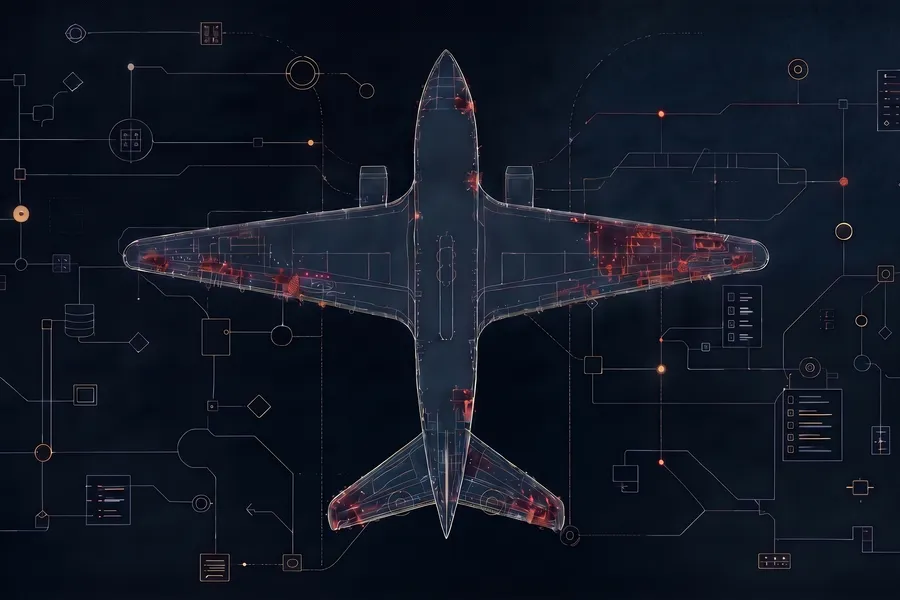
The story of the planes that returned from war with bullet holes is a useful analogy.
During World War II, aircraft that came back damaged were analyzed to decide where to reinforce their armor. The initial interpretation was to reinforce the most damaged areas. But Abraham Wald, a mathematician at the Statistical Research Group, saw the problem differently: the observed planes were the ones that had managed to return. The areas with no visible impacts on those planes were probably the most critical, because planes hit there did not come back.
It was a survivorship bias problem.
Something similar happens with production systems.
We see systems full of patches, workarounds, uncomfortable integrations, and inelegant processes because those are the systems that managed to keep operating. The ones that did not survive are no longer available for diagnosis. They were replaced, abandoned, absorbed into manual processes, or simply stopped supporting the business.
That does not make a surviving system a good system. But it does require treating it with more respect.
If an imperfect system allowed the company to sell, invoice, serve customers, fulfill contracts, operate for years, and keep a business need alive, then there is learning inside it. There are decisions to understand before intervening.
The question should not only be: “why is this so badly built?”.
It should also be: “what problem was this solving that allowed it to continue existing?”.
The arrogance of the familiar pattern
Another risk appears when we try to force other people’s systems into the patterns we already know.
It is very human. We see a problem and translate it into our own experience: this system should be rewritten with this framework, this architecture should move to events, this workflow should be automated with AI, this process should look like the one we already implemented in another industry.
The problem is that experience can also become a filter.
When we know little about an operation, we tend to overestimate how much we understand. The system looks simpler than it really is. Its edges are not clear yet. Its exceptions have not appeared. Its invisible rules have not hit us yet.
From that perspective, rewriting looks easy.
But the more you understand a production system, the more the real complexity appears: undocumented dependencies, implicit commercial rules, historical decisions, partially fixed errors, users who learned to operate around the system, manual controls that exist because the risk was too high, reports nobody can break because they feed important decisions.
That is when the conversation changes.
Modernization is not imposing an ideal architecture on a reality we do not yet understand. Good modernization requires first understanding why that reality took its current shape.
What changes when AI enters
All of this becomes more important with AI.
AI can make a superficial intervention look more powerful than it really is. It can automate steps, summarize documents, classify cases, answer questions, generate reports, assist decisions, or execute tasks inside a workflow. But if it is applied to a poorly understood process, it can also amplify errors.
It can speed up a process that should not be accelerated.
It can remove a human review that was actually acting as a control.
It can turn an important exception into a “rare” case the system ignores.
It can produce plausible answers over incomplete data.
It can hide complexity behind a more convenient interface.
That is why many AI initiatives remain demos. Not because the model is bad, but because the demo does not carry everything production carries.
The demo lives in a clear case. Production lives at the edge.
The demo responds well when the context is clean. Production has dirty data, permissions, auditability, responsibilities, costs, real users, and consequences.
The demo shows capability. Production requires governance.
Before automating, diagnose
A good technology intervention does not start by asking which model to use, which tool to buy, or which system to replace.
It starts with less glamorous questions:
Why does this process exist in this form?
Which part is technical debt and which part is operational knowledge?
Which exceptions are noise and which ones protect the business?
Which manual steps are useless friction and which ones work as controls?
Which decisions can be automated and which ones require human review?
Which systems can be replaced and which ones need to coexist during a transition?
What breaks if we accelerate this without understanding it?
These questions are not a way to slow modernization down. They are a condition for modernization to work.
AI can be a powerful tool for redesigning operations, reducing repetitive work, improving response times, detecting risks, and increasing team capacity. But its value does not appear by attaching an intelligent layer on top of any existing workflow.
It appears when the process is understood, real friction is identified, and controls are designed so intervention does not break what still supports the business.
Respect for what works, judgment to change it
A production system that still works deserves credit. Not because it is perfect, but because it allowed an organization to solve a need for long enough to keep existing.
That does not mean leaving it untouched. It also does not mean justifying all technical debt as historical wisdom.
It means intervening with better judgment.
Some parts probably need to be removed. Others need to be redesigned. Others need to be automated. And some, at least for a time, need to remain because they contain rules, controls, or learning that has not yet been replaced by something better.
The difference is not arriving with the answer before understanding the system.
In production, ugly is not always useless. Old is not always wrong. Manual is not always backward. And modern is not always better.
Before automating with AI, we need to understand the history carried by the current system.
Because modernization is not erasing a company’s operational past.
It is learning enough from it to build something better.